Battery Energy Storage Yard Construction in Oklahoma
With renewables supplying 47% of the electricity Oklahoma generates, storage is no longer a side topic for a data center owner. A battery energy storage yard is a group of containerized or cabinet battery systems, inverters, transformers and controls set on a graded, fenced pad, usually beside a substation or a power plant. For a data center it can ride through a grid disturbance, shave a demand peak, firm up wind output, or provide the bridge between a utility outage and generator start.
The yard is a young building type. Codes, standards and utility practices are changing as quickly as the batteries inside. That makes the builder's role more demanding: we need to know which edition of the fire code applies, which test standard the authority expects, how the manufacturer wants the pad built and how a thermal event will be handled. We keep a record of each of those decisions with the owner.
We build battery yards as a stand-alone project for power developers and as a part of a data center campus. In both cases the civil work is similar: a clean, level, well-drained pad with proper spacing between units, fire access roads, a grounded fence, oil and electrolyte containment where required, and trenches for medium-voltage cable and controls.
Wind, load and where storage fits
Oklahoma's energy position explains why storage appears on so many project lists. The state produces 61% more energy than it consumes, energy costs run 17% below the national average, and the Traverse Wind Energy Center alone is 998 MW. In western Oklahoma, wind farms near Elk City (82 turbines producing 123 MW, commissioned in June 2009) and in Woodward County (listed at 198.6 MW and 148.4 MW) show how much generation sits far from the load centers. A Custer County wind park near Weatherford has been described as planned to reach as many as 98 turbines of 1.5 megawatts each.
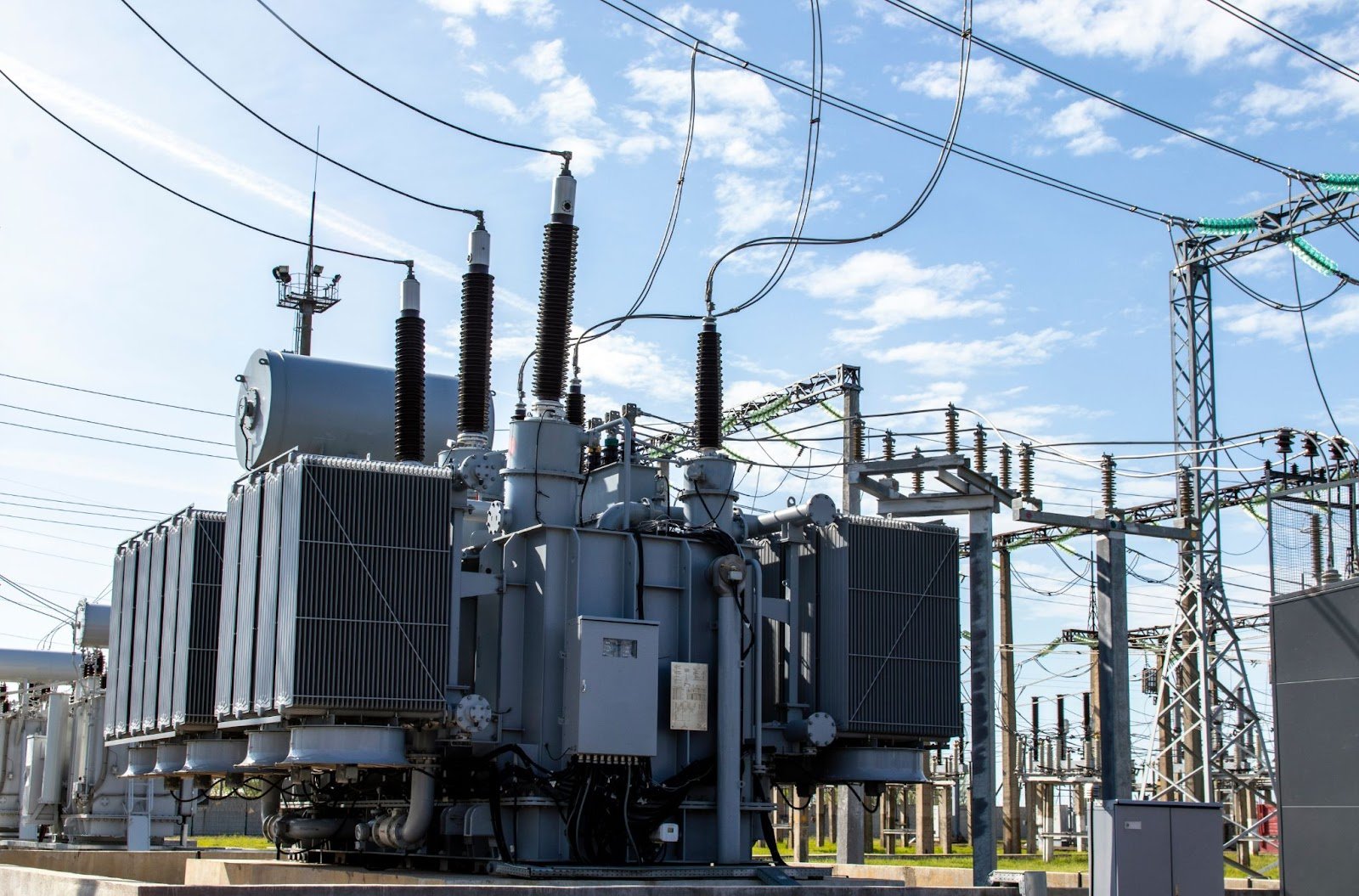
A data center that connects in that region can use storage to smooth the match between wind output and its own demand. The owner and the utility decide how, but the builder needs to know where the yard can go, how it ties into the substation, and what the pad requires. See our on-site substation yard page for the interconnection side.
What goes into a battery yard
Our scope includes site clearing, grading, drainage, compaction testing and a gravel or concrete surface. We set foundations or piers for each battery enclosure, inverter skid and transformer, install grounding, build conduits and cable trenches, and erect fencing and gates. We also build the fire access lanes, since emergency responders need a route they can use in an emergency and room to work around the units.
Battery installation, wiring and commissioning are usually done by the system supplier's crews and licensed electrical contractors. We coordinate their access and keep the pad ready. For the smaller battery rooms inside a building, rather than a yard, see our battery and UPS rooms service.
Fire, thermal events and responders
Battery fires are a different risk than diesel fires. Lithium-ion systems can undergo thermal runaway, and the response usually involves letting a unit burn while protecting neighbors rather than attempting to extinguish it. The design therefore relies on spacing, fire barriers, detection, ventilation and a response plan. We follow the manufacturer's installation manual, the engineer of record's spacing, and the fire marshal's review.
We also meet with the local fire department before the system is energized, give them the site plan and the shutdown procedures, and offer a site walk. Responders in rural areas may have limited resources, and it is better for them to see the yard before an incident. The same logic applies to the generator and fuel yard, which is often next door.
Which fire code and electrical code applies
The City of Sapulpa's adopted-code notice lists the International Fire Code adopted by the state, and the state commission has since adopted a newer National Electrical Code and the International Codes. Cities adopt and enforce their own editions, so a yard in one county may be reviewed under different rules from a yard in another.
Energy storage often falls under the fire code's dedicated provisions, and some local authorities ask for hazard mitigation analysis or large-scale fire testing data. We ask for the manufacturer's test documentation early, share it with the authority, and keep the file with the permit set. Our permitting and utility interconnection service covers that process.
Ground, quakes and weather
A battery yard is heavy and sensitive to settlement. We test the soil, compact the pad and check bearing capacity under the planned loads. Seismic activity is a consideration in Oklahoma: at least six earthquakes were recorded near Edmond in mid-January 2024, two of them above magnitude 4, and the largest recorded events were magnitude 5.8 at Pawnee in 2016 and 5.7 at Prague in 2011. We design enclosure bases, cable connections and bracing to the seismic category the engineer specifies.
Wind and hail affect outdoor equipment, so we confirm the manufacturer's ratings, and we plan cable routing that avoids water collection. Temperature extremes affect battery performance and cooling, which the supplier handles, but the pad design must allow space for service and airflow. Drainage matters as much as bearing: standing water under cabinets corrodes connections, so we shape the pad to shed water away from the units and keep cable trenches sloped to a sump or an outfall. Our relationships with hyperscale cloud providers and power developers ensure we understand the owner's expectations for uptime.
Send the single-line and the pad layout
Share the system supplier's drawings, the interconnection point and the site plan. We will respond with a pad design, an access plan and a schedule.
Common Questions
Do battery yards need a separate fire permit?
Often yes. Local fire authorities review energy storage separately, and the permit path depends on the system size and the edition of the fire code in force. We ask the fire marshal early.
How far apart do the battery containers need to be?
The spacing comes from the manufacturer's test data and the code. We build to the engineer's drawings and do not guess. Spacing affects pad size and cost.
Can a battery yard sit in a floodplain?
We avoid it. If the yard must be near water, elevation, drainage and cable connections need special design, and the fire authority may ask for more detail. We check flood maps before pad layout.
Who commissions the batteries?
The system supplier and a licensed electrical contractor, with the owner's engineer and the utility. We support them by keeping the pad ready and providing access, power and safe working conditions.
How long does a yard take to build?
The civil work typically takes weeks to a few months, depending on size. The critical path is more often equipment delivery and utility interconnection than the pad itself.
Plan Your Oklahoma Data Center Project
Tell us about the site, the power and cooling plan and the schedule, and we will set up a review of scope, schedule, permits and inspections.
Request a Project Review