Data Center Construction Support for Utilities and Power Developers in Oklahoma
The Weatherford Wind Energy Park was described as planned for as many as 98 turbines of 1.5 megawatts each across more than 5,000 acres of Custer County, with the turbines visible from I-40. Do the arithmetic and the plant is on the order of 147 MW of nameplate capacity. That single plant is smaller than many data center campuses now being discussed in the state, which is why utilities and power developers are talking with data center builders at all.
We build for the people on the supply side of that conversation: electric utilities and cooperatives extending service to a new large customer, independent power developers that want to sell directly to a campus, and the owners of storage or on-site generation who need a pad, a yard and a fence delivered on schedule. Their work is measured in interconnection milestones, outage windows and permits, and our job is to deliver the civil, structural and yard work that sits between those milestones.
The sections below describe how we work with utilities and developers, which parts of a project we manage and where our responsibility ends and the utility's begins.
Early conversations with the utility and the county
Our approach on any large-load project is to ask the utility three questions before the owner buys land: what voltage and capacity can be delivered, on what in-service date, and what construction responsibility sits with the customer. The answers set the shape of the substation yard, the location of the main service entrance and the schedule float. We prefer to hear them from the utility's engineer, in writing.
We apply the same discipline to the county. County commissioners, planning staff and the economic development team decide whether a site is welcome, and they care about roads, water, emergency access and tax base. By sitting down with them early, we have seen projects avoid late conflicts over haul routes and gate locations. Our service on utility and substation site work reflects what the utilities ask for most often.
A state that makes more energy than it uses
The Oklahoma Department of Commerce states that Oklahoma produces 61 percent more energy than it consumes, that renewables generate 47 percent of the state's electricity and that energy costs run 17 percent below the national average. In the western part of the state, wind plants are a familiar sight: the Red Hills wind farm near Elk City is reported to have 82 turbines producing 123 MW, commissioned in June 2009. Reports like these come from secondary sources, so a developer should confirm plant data with the operator before using it in a proposal.
Industrial campuses are also looking at their own power. At MidAmerica Industrial Park near Pryor, the park's own site describes custom electricity supplied by the Grand River Dam Authority, a model in which the utility and the park coordinate service for large tenants. That arrangement is worth studying wherever a developer is assembling a campus.
The civil and structural work we manage
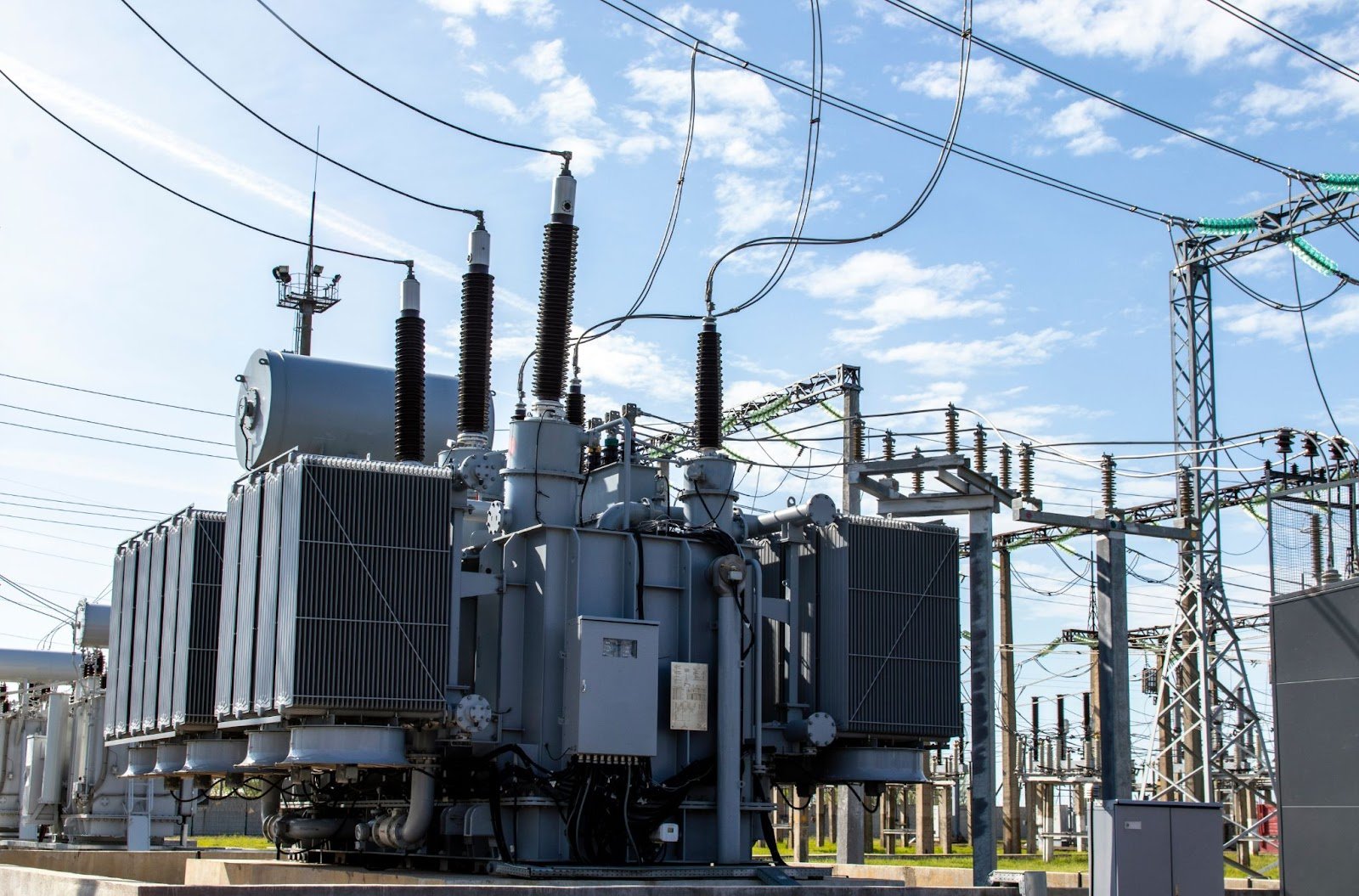
A substation, switchyard or storage yard begins as earthwork, drainage and foundations. We manage the pad grading, the stormwater features, the foundations for transformers and breakers, the grounding grids and the stone, containment and perimeter fence. Utilities and developers like this arrangement because it concentrates responsibility for site quality in one team, and the electrical contractor arrives to a finished, surveyed pad.
We also manage the underground duct banks and the heavy conduit runs that connect a yard to the data hall, with spare ducts for future circuits. Our standard is to pour concrete encasement in a single schedule rather than leave open trench through a wet spring, and to compact backfill in lifts that match the geotechnical report. The on-site substation yard building type shows how these pieces fit on a typical site.
Outage windows, energization dates and weather
Utility work comes with outage windows that cannot be moved, usually negotiated months in advance with system operators. We protect those windows by finishing everything that does not require an outage before they open: foundations, steel, conduit, control houses and testing access. When the window arrives, the utility and its electrical contractor have a prepared site and can concentrate on the energization steps.
Energization also depends on weather and testing. We plan lay-down areas and temporary roads that can take heavy equipment after rain, and we keep dewatering and erosion controls in service through the storm season. A developer who plans to bring a large load online should expect the final weeks to be driven by commissioning and utility acceptance tests, so the schedule includes time for retests. Hyperscale buyers depend on this logic, as described in our page for hyperscale cloud providers.
Storage, backup generation and on-site power
Developers are increasingly pairing generation with storage and with backup generation at the customer's site. In Chickasha, a June 2025 state release described a joint venture to supply on-site power to sectors such as data centers, critical minerals processing and advanced manufacturing. We build the foundations, containment, fire access roads and enclosures for such systems, along with the generator yards and fuel systems that serve backup power.
For battery projects, the key site questions are drainage, fire department access, separation distances and the thermal behavior of the pad. Our knowledge of the battery energy storage yard type covers those considerations, and we coordinate with the fire marshal on access and signage before the first container is set.
Permits, water and land agreements
Power projects raise land, water and permit questions that differ from building projects. Easements and crossing agreements need to be recorded before the contractor mobilizes. Water use for construction dust control and for plant cooling must be tracked, as the Oklahoma Water Resources Board maintains permit applications, use reports and a dashboard of pending permits. We keep a log of water use for every site and include it in the project closeout.
Developers who are assembling land for a campus should also read our page for real estate developers and site owners, since the commercial decisions about land, access and sequencing are often shared between a power developer and a landowner. We help both sides with the site plan and the construction schedule so that the work they each promised can happen in order.
Tell us the in-service date and the voltage
Share the interconnection study, the easements and the target energization date. We will return a site work scope that separates our civil and structural package from the utility's own equipment.
Common Questions
Do you build the utility's substation or the customer's?
We build the civil and structural parts of either one, under contract to the owner of that yard. The utility's own crews or contractors install its protection and metering equipment, and we coordinate access and sequence with them.
How do you coordinate with a wind or solar developer on a shared easement?
We ask for the recorded easements and crossing agreements before mobilizing, locate buried and overhead lines, and set up access and haul routes that respect each party's rights. Where a crossing is required, we obtain written approval from the easement holder first.
What is the main schedule risk on a utility interconnection?
The utility's in-service date, which depends on equipment delivery and the system operator's outage window. Our civil work is usually not the long pole, so we try to finish ahead of the equipment and avoid being the reason an outage window is missed.
Can you work on a campus where the utility is the landlord?
Yes. On campuses where a utility or authority controls power and land, we coordinate with both on road widths, utility corridors and tenant standards. The Soldier Creek Industrial Park in Midwest City, owned by the city's utilities authority, is one example of that structure.
Do you build energy storage?
We build the civil and structural parts of storage yards: pads, drainage, containment, fire access and fencing. The storage vendor or integrator supplies and commissions the batteries, and we coordinate site readiness with them.
Plan Your Oklahoma Data Center Project
Tell us about the site, the power and cooling plan and the schedule, and we will set up a review of scope, schedule, permits and inspections.
Request a Project Review